Showing posts with label East Germany. Show all posts

Friday, July 13, 2012

East German National Volksarmee Generalmajor Ausgangsuniform

When East Germany was officially declared a sovereign state in 1949 by the Soviet Union, it had already begun rearming in secret. It was not until the official formation of the West German Bundeswehr in 1955, that the East German's responded with the establishment of the National Volksarmee (National People's Army) in 1956 from elements of the Kasernierte Volkspolizei (Barracked People's Police). From the beginning the National Volksarmee was the 'Parteiarmee" tasked with defending the people and the Party. Under this euphomism, all officers were required to be members of the ruling SED communist party. Political officers charged with instruction of the troops on ideological, military, and global affairs formed an essential part of NVA daily routine known as Politische Hauptverwaltung (Political Main Administration).

Like the Communist parties of other socialist states, the Socialist Unity Party of Germany, or SED, assured complete control by appointing loyal party members to top positions and organizing intensive political education for all ranks. The proportion of SED members in the officer corps rose steadily after the early 1960s, eventually reaching almost 95 percent of the total officer corps.
The official emblem of the East German National Volksarmee reading "For the Protection of the Workers and Farmer's Power"
The NVA described itself as the instrument of power of the working class. According to its doctrine, the NVA protected peace and secured the achievements of socialism by maintaining a convincing deterrent to imperialist aggression. The NVA's motto, inscribed on its flag, was "For the Protection of the Workers' and Farmers' Power."

While West Germany saw itself as the legal successor to the Third Reich, shouldering the burdens of legal responsibility for its crimes; East Germany renounced ties to the Nazi past, styling itself as the "anti-fascist rampart" and proclaiming itself the first socialist state on German soil.

The uniform displayed here is the Ausgangsuniform (Semi-Dress/Walking-Out Uniform)  for a Generalmajor (Major General) in the Landstreitkräfte (LaSK) which were the Army or Ground Forces. The rank of Generalmajor is equivalent to an American 1 star Brigadier General,  a British Brigadier. The uniform is the standard stone grey color of all National Volksarmee (East German Armed Forces) services with the red colored piping and gold insignia denoting the wearer's status as a General officer in the Ground Forces. The pants are the standard stone gray color as well with the reflecting red striping running along the length of the pant leg. 

The tunic would be worn with a white shirt. During periods of warm weather, there was the option of omitting the tunic, and furthermore omitting the tie.


 The visor cap is of the gabardine material of all East German uniforms. Unlike West German uniforms denoting branch as the central insignia and then flanked by the national roundel, East German visor caps used the East German national insignia as the centerpiece with the national insignia of a hammer and compass surrounded by wreaths of wheat and German flags. Surrounding the roundel on this example are laurel wreaths and applied with a felt background against the face of the hat. This is unique to all General officer hats as other officers junior in rank wore silver metal insignias. Rather than wear wreaths on the visor like the West German's, East German officer's wore braided cords around the cap reminiscent of styles of previous German armies.


Shown here is the gold metal Kragenspiegeln (Collar Insignia) of the General Officer Corps. They are nearly identical to the types of Kragenspiegeln worn by General officers in the Nazi Wehrmacht. The East German military borrowed heavily from the previous regime in terms of uniform style as well as maintaining a sense of Germanic tradition in using heavy Prussian influence. 


Shown here is a detailed picture of  the shoulder board insignia of a Generalmajor of the Land Forces.  


Here shown are the gold buttons of a General officer bearing the national hammer and compass insignia of the German Democratic Republic. 


General Officer Corps red waffenfarbe stripe around the cuff of the uniform sleeve. 

 On the right side of the chest would have been an Academy badge denoting the officer school that the General attended. On the left side of the chest of the uniform would have been either medals or a ribbon bar depending on the type of event attended.


An illustration displaying the Ausgangsuniform (Semi-Dress/Walking-Out Uniform)  and the Dienstuniform (Service Uniform) of officers and Generals in the Landstreitkräfte (LaSK). The center picture showing the Service uniform, and the right displaying the Semi Dress uniform configuration.

Sunday, June 24, 2012

The Berlin Wall & Inner German Border Zone

Following the end of the Second World War and the division of post war Germany among the victorious allies, the areas of occupation gradually began to adopt the ideological policies of their governing authorities. Joseph Stalin, leader of the Soviet Union revealed his intention to communist allies in eastern Germany that he planned to undermine western efforts to democracize Germany first by undermining British authority in it's zone and he expected the Americans to withdraw from its zone of occupation within a span of two years which would lead the way for Soviet invasion and the domination of Germany under a purely communist regime.

The East German government was closely modeled on it's Soviet parent and numerous other organizations and security apparatuses were installed to suppress the population. Property and industry were nationalized in the East German zone along the Soviet ideology of communism. If statements or decisions deviated from the described line, reprimands and, for persons outside public attention, punishment would ensue, such as imprisonment, torture and even death were the end results. The mandatory indocrination into Marxist-Leninist philosophy sent many citizens of the Soviet zone fleeing for freedom from persecution in the western zones. West Germany became a Soziale Marktwirtschaft (Social Market Economy) embracing capitalist ideas and soon enjoyed a twenty year period of prosperity known as the Wirtschaftswunder (Economic Miracle). As the situation improved in post war West Germany, the standard of living and economic situation also improved and many East Germans wanted to move there to better themselves.


 The Soviets soon installed a system of immigration restrictions and close monitoring of the population. Under Stalin's influence, in 1952 the Inner German Border which separated West & East Germany was closed and barbed wire fences erected. However, in divided Berlin the border zone remained open. Berlin became many East Germans only route of escape into the West. It also became the epicenter for rising tensions between the United States and Soviet Union. With the Inner German Border closed, East Germany attempted to restrict movement into West Berlin by introducing a new passport system in 1957. Those caught trying to leave were heavily fined however with no physical barriers and a subway system running between the two halves of the city these measures were for the most part useless. By 1961, nearly 20% of the East German population had escaped to freedom in the West.

The majority of the immigrants were young and well educated and sought the freedoms of the West. This mass exodus was referred to by the communist regime as a 'brain drain' Most immigrants officially stated their reasons for leaving were political more than materialistic. 

A border watch tower along the Inner German Border with West Germany
East German troops along a mere fenced border between the two Germanys
Initially denying his intentions, East German leader Walter Ulbricht along with support from the new Soviet leader Nikita Khrushchev soon signed the initiative to close the borders and erect a wall around West Berlin. At midnight, East German police and military units had effectively sealed the border in Berlin and on 13 August 1961, construction units and workers began tearing up the roads adjacent to the border making them impassable to vehicles and positioning obstacles along the border. Barbed wire fences and entanglements were installed surrounding the entire length of West Berlin effectively sealing it off from East Germany. The barriers were slightly within East German territory to ensure it did not violate West Berlin's sanctitiy at any time. On 17 August, the first cement bricks were put in place to begin the construction of the Berlin Wall itself. East German Army and members of the Kampfgruppen (Combat Groups of the Working Class) were positioned along lengths of the border with orders to shoot anyone attempting to flee East Germany. Additionally, chain fences, walls, minefields and other obstacles were installed along the length of East Germany's western border with West Germany proper. A huge no man's land was cleared to provide a clear line of fire for Border Guards and police units attempting to stop defecting refugees.

Almost overnight, entire families were separated and Republikflucht (Desertion of the Republic) was made a capital offense by the East German government. Hundreds were shot and killed trying to cross the Berlin Wall, and estimates show that nearly 75,000 were caught and imprisioned for trying to escape into West Berlin between 1961 and 1989. Officially East German government officials declared the Wall an Antifaschistischer Schutzwall (Anti-Fascist Protective Rampart) intended to dissuade aggressive influences from the West.The Wall was essentially a public relations disaster for communist officials attempting to improve their image with the people. There nine crossing points into Berlin where citizens could cross into West Berlin and these were closely monitored by Border Troops and Secret Police units. Several subsequent crossings were established for West Germany to use crossing into East Germany and four autobahns (highways) were established linking West Berlin to West Germany.

A sign notifying American personnel of their proximity to the Inner German Border region
 The East German government did not allow apartments along the border to be occupied and the windows and doors of many facilities were bricked up. The East German government issued Schießbefehl or shooting orders to border guards when dealing with defectors. The official stance from East German officials were "Do not hesitate to use your firearm, not even when the border is breached in the company of women and children, which is a tactic the traitors have often used".

A U.S. Army Cobra gunship flies along the Inner German Border in southern West Germany
The most famous of the crossing points that linked West Germany to West Berlin, through East German territory was  the Berlin-Helmstedt autobahn, which entered East German territory between the towns of Helmstedt and Marienborn (Checkpoint Alpha), and which entered West Berlin at Dreilinden (Checkpoint Bravo for the Allied forces) in southwestern Berlin. Access to West Berlin was also possible by railway (four routes) and by boat for commercial shipping via canals and rivers. Non-German Westerners could cross the border at the Friedrichstraße station in East Berlin and at Checkpoint Charlie. When the Wall was erected, Berlin's complex public transit networks, the S-Bahn and U-Bahn, were divided with it. Some lines were cut in half; many stations were shut down. Three western lines traveled through brief sections of East Berlin territory, passing through eastern stations (called Geisterbahnhöfe, or ghost stations) without stopping. Both the eastern and western networks converged at Friedrichstraße, which became a major crossing point for those (mostly Westerners) with permission to cross.


Escape attempts curtailed with the construction of the Berlin Wall, however defections did occur one of the most famous being the defection of Conrad Schumann during the construction of the Berlin Wall. With merely a low barbed wire entanglement separating Berlin, West German citizens shouted to him, "Komme über!" ("Come over!"). A West German police car pulled up to wait for him. With the motiviation to defect Schumann jumped over the barbed wire fence and was promptly driven away from the scene by the West Berlin police. West German photographer Peter Leibing photographed Schumann's escape, and this picture has since become an iconic image of the Cold War.

The first death in attempt to defect was a young woman in August of 1961 when she jumped from the third floor of her apartment. A twenty four year old tailor would be the first shooting victim when he was shot by border guards while trying to swim across Spree Canal to West Germany.

East German citizens still managed to successfully defect by a variety of methods: digging long tunnels under the wall, waiting for favorable winds and taking a hot air balloon, sliding along aerial wires, flying ultralights, and in one instance, simply driving a sports car at full speed through the basic, initial fortifications. When a metal beam was placed at checkpoints to prevent this kind of defection, up to four people (two in the front seats and possibly two in the boot) drove under the bar in a sports car that had been modified to allow the roof and windscreen to come away when it made contact with the beam. They lay flat and kept driving forward. The East Germans then built zig-zagging roads at checkpoints. The sewer system predated the wall, and some people escaped through the sewers, in a number of cases with assistance from a prominent student group.

Many escapees were wounded attempting to flee into the West and if they were within the 'death strip' no matter their proximity to the western side, Westerners could not interfene to assist the wounded out of fear of provoking attack from East German forces. East German border guards notoriously left would be defectors to bleed to death in this area such was the most infamous case regarding 18 year old Peter Fechter.

 Soon after the construction of the Wall, Fechter along with a friend jumped into the death strip and were immediately fired upon by East German border guards. Fechter's friend managed to escape over the wall however, while atop the Wall; Fechter himself was shot in the pelvis before hundreds of witnesses in West Berlin. Wounded, Fechter fell back into the death-strip on the East German side. He remained in view of Western onlookers, including journalists screaming in pain for assistance. Despite his screams; he received no medical assistance from the East side, and could not be tended to by those on the West German side. He bled to death after approximately one hour. Sparked by outrage, the East Germans did enter the death strip and retrieve his body an hour or so after he died. As a result many West Germans demonstrated shouting "Murderers!" at the East German guards.

The negative attention as a result of the Fechter incident, prompted East German officials to order stricter rules for firing weapons in public weapons. The last shooting death along the Wall occurred in 1989.

It is estimated that 5,000 people successfully escaped through the Berlin Wall into West Germany. Almost 200 were confirmed killed attempting to escape and another 75,000 were wounded attempting to defect. 


 With U.S. President Ronald Reagan's official statement to Soviet leader Mikhail Gorbachev in 1987 challenging him to tear down the Wall, and Hungary dismantling it's border obstacles allowing East Germans to flee into Austria in 1989, mass demonstrations began in East Germany denouncing the communist regime. No one in the East German government wanted to be held responsible for ordering the use of force against protestors and so the Army and police forces were held in restraint. On 9 November 1989, segments of the Berlin Wall were officially torn down and border crossings were reopened in December. Official dismantling of the Wall by the East German government began in June of 1990 and East and West Germany were officially reunified on 3 October 1990. 

A West German border sign announcing the Border between West & East
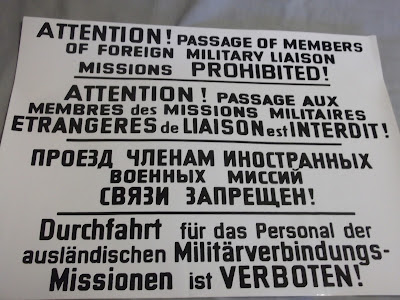
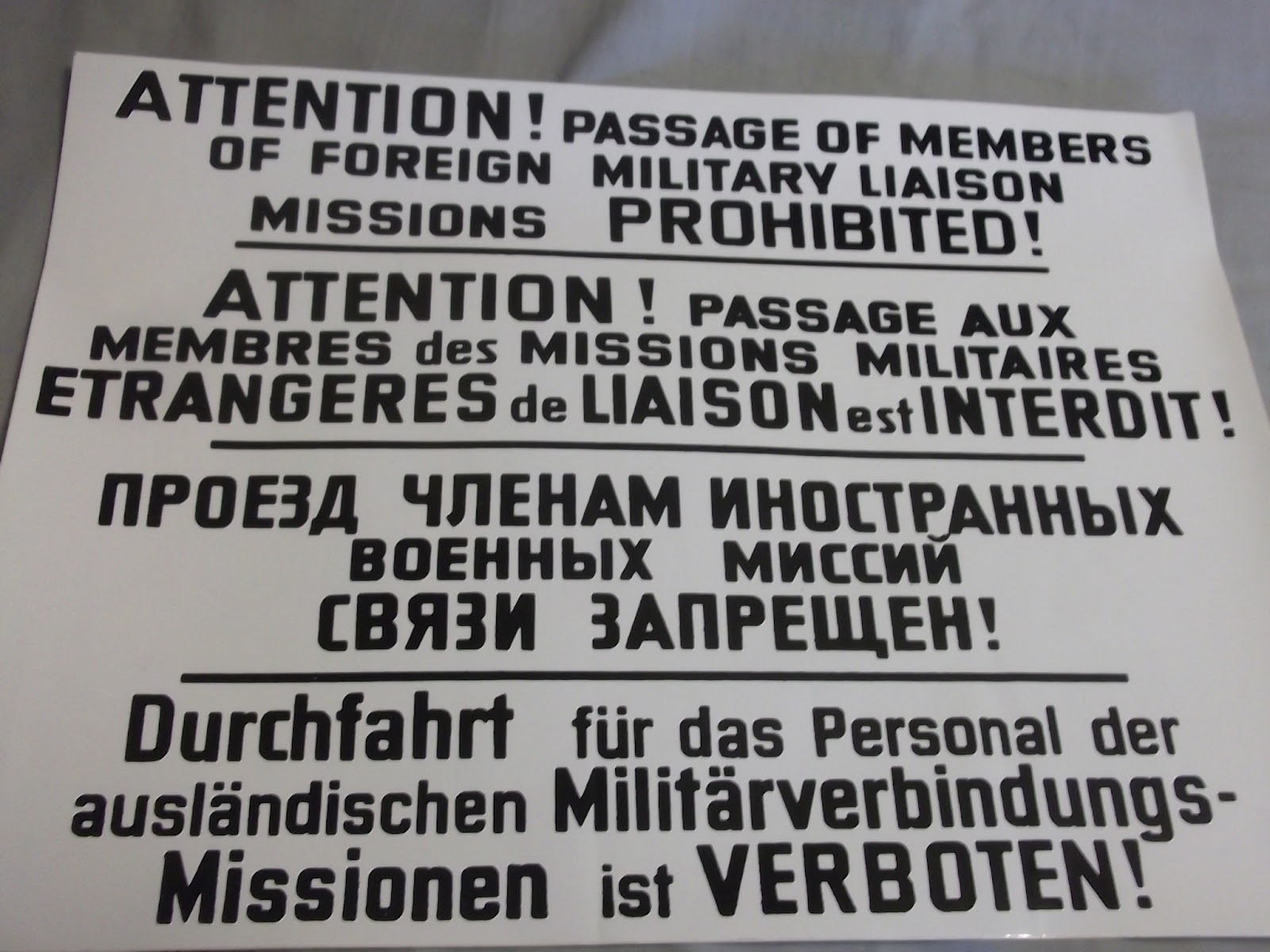
Another border sign announcing the proximity of the border in German, English, French & Cyrillic
Another sign from a border checkpoint in English, French, Cyrillic & German

Small pieces of the Berlin Wall and a 1982 issue of National Geographic magazine highlighting the situation in divided Berlin

A member of the East German Wachregiment Friedrich Engels participates in the ceremonial changing of the guards at the Neue Wache in East Berlin as American servicemen and onlookers look on

Small fragments of the Berlin Wall which divided Berlin and became a symbol of the Cold War from 1961 - 1989

An assortment of photographs from the 1960s documenting the situation in divided Berlin along the Berlin Wall. 


A case for the photographs reading Berlin zerrisson durch Mauer und Stacheldraht (Berlin torn apart by Wall and barbed wire)


A photograph of Allied Checkpoint Charlie in West Berlin. The caption on the back of the photograph reads Ausländerübergang (Checkpoint) an der Friedrichstraße plick von West nach Ost (Checkpoint for foreigners on Frederick Street view from the West to the East Sector


The view of the Oberbaum Bridge across the Spree River in Berlin. It was a pedestrian crossing between West & East Berlin for residents of West Berlin only. The caption on the back of the photograph reads Mahnmal Oberbaumbrücke (Momento at the Oberbaum Bridge)


A photograph taken from West Berlin across the Wall into East Berlin as Border Guards and Peoples Police personnel patrol the East German side of the wall. The caption on the back of the photo reads Blick in die Wilhelmstraße (View of William Street)


A view of how the Berlin Wall literally ran across the middle of streets cutting off the city in it's center. The caption reads Die Mauer in der Bernauer Straße (The Wall in Bernau Street). Note how the windows closest to the Wall are boarded or bricked up to prevent escape from the Eastern sector into the West.


A checkpoint along the Wall in Berlin. The photo caption reads Durchgang durch die Mauer in der Heinrich-Heine-Straße (Entrance in the Wall at Heinrich Heine Street)


The official view of religion in East Germany being a communist state was a standardized promotion of atheism and many churches were neglected during the East German reign. The photograph here is of the famous Reconciliation Church as seen from West Berlin, behind the Wall in the Eastern Sector. The caption reads Bernauer Straße mit Versohnungskirche (Bernau Street with the Reconciliation Church)


Workers work to brick up the windows of buildings facing the Western Sector of Berlin. The caption of this photograph reads Zugemauerte Fenster in der Bernauer Straße (Walled up windows in Bernau Street)

Sunday, June 10, 2012

Warsaw Pact

Warsaw Pact military alliance showing the flags of member states

The Warsaw Treaty Organization of Friendship, Cooperation, and Mutual Assistance (1955–1991), more commonly referred to as the Warsaw Pact, was a mutual defense treaty between eight communist states of Eastern Europe in existence during the Cold War. The founding treaty was established under the initiative of the Soviet Union and signed on 14 May 1955, in Warsaw, Poland. The Warsaw Pact was the military complement to the Council for Mutual Economic Assistance (CoMEcon), the regional economic organization for the communist states of Eastern Europe. The Warsaw Pact was a Soviet military response to the integration of West Germany into NATO in 1955, per the Paris Pacts of 1954.

The Warsaw Treaty’s organization was two-fold: the Political Consultative Committee handled political matters, and the Combined Command of Pact Armed Forces controlled the assigned multi-national forces, with headquarters in Warsaw, Poland. Furthermore, the Supreme Commander of the Unified Armed Forces of the Warsaw Treaty Organization was also a First Deputy Minister of Defense of the USSR, and the head of the Warsaw Treaty Combined Staff also was a First Deputy Chief of the General Staff of the Armed Forces of the USSR. Therefore, although ostensibly an international collective security alliance, the USSR dominated the Warsaw Treaty armed forces.
Strategy

The strategy of the Warsaw Pact was dominated by the desire to prevent, at all costs, the recurrence of an invasion of Russian territory as had occurred under Napoleon in 1812, German forces in 1918 (ended with the Treaty of Brest Litovsk) as well as Hitler in 1941, leading to extreme devastation and human losses in all cases, but especially in the third; the USSR emerged from the Second World War with the greatest total losses in life of any participant in the war.

On 14 May 1955, the USSR established the Warsaw Pact in response to the integration of the Federal Republic of Germany into NATO in October 1954 – only nine years after the defeat of Nazi Germany (1933–45) that ended with the Soviet and Allied invasion of Germany in 1944/45 during World War II in Europe. The reality was that a "Warsaw"-type pact had been in existence since 1945, when Soviet forces initially occupied Eastern Europe, and maintained there after the war. The Warsaw Pact merely formalized the arrangement.

The eight member countries of the Warsaw Pact pledged the mutual defense of any member who would be attacked; relations among the treaty signatories were based upon mutual non-intervention in the internal affairs of the member countries, respect for national sovereignty, and political independence.

The founding signatories to the Treaty of Friendship, Cooperation and Mutual Assistance consisted of the following communist governments:

People's Republic of Albania (withheld support in 1961 because of the Sino–Soviet split, formally withdrew in 1968)
People's Republic of Bulgaria
Czechoslovak Republic (Czechoslovak Socialist Republic since 1960)
German Democratic Republic (withdrew in September 1990, before German reunification)
People's Republic of Hungary
People's Republic of Poland
People's Republic of Romania (Socialist Republic of Romania from 1965)
Union of Soviet Socialist Republics

For 36 years, NATO and the Warsaw Treaty never directly waged war against each other in Europe; the United States and the Soviet Union and their respective allies implemented strategic policies aimed at the containment of each other in Europe, while working and fighting for influence within the wider Cold War on the international stage.

In 1956, following the declaration of the Imre Nagy government of withdrawal of Hungary from the Warsaw Pact, Soviet troops entered the country and removed the government.

The multi-national Communist armed forces’ sole joint action was the Warsaw Pact invasion of Czechoslovakia in August 1968. All member countries, with the exception of the Socialist Republic of Romania and the People's Republic of Albania participated in the invasion.

Beginning at the Cold War’s conclusion, in late 1989, popular civil and political public discontent forced the Communist governments of the Warsaw Treaty countries from power – independent national politics made feasible with the perestroika- and glasnost-induced institutional collapse of Communist government in the USSR. In the event the populaces of Hungary, Czechoslovakia, Albania, East Germany, Poland, Romania, and Bulgaria deposed their Communist governments in the period from 1989–91.

On 25 February 1991 the Warsaw Pact was declared disbanded at a meeting of defense and foreign ministers from Pact countries meeting in Hungary. On the 1 July 1991, in Prague, the Czechoslovak President Václav Havel formally ended the 1955 Warsaw Treaty Organization of Friendship, Cooperation, and Mutual Assistance and so disestablished the Warsaw Treaty after 36 years of military alliance with the USSR. Five months later, the USSR disestablished itself in December 1991.

Ministerium für Staatssicherheit

The emblem of the East German Ministry for State Security

The Ministerium für Staatssicherheit or Ministry for State Security, often abbreviated as MfS, or commonly refered to as the Stasi was the official state security service of the German Democratic Republic. The Stasi was headquartered in East Berlin, with an extensive complex in Berlin -Lichtenberg and several smaller facilities throughout the city. It was widely regarded as one of the most effective and repressive intelligence and secret police agencies in the world. The Stasi motto was "Schild und Schwert der Partei" (Shield and Sword of the Party), that is the ruling Socialist Unity Party of Germany (SED). Now considered a criminal organisation, several Stasi officials were prosecuted for their crimes after 1990.

The Stasi was founded on 8 February 1950. It was modelled on the Soviet MGB, and was regarded by the Soviet Union as an extremely loyal and effective partner organization. Wilhelm Zaisser was the first Minister of State Security of the GDR, and Erich Mielke his deputy. Zaisser, who tried to depose SED General Secretary Walter Ulbricht after the June 1953 uprising was after this removed by Ulbricht and replaced by Ernst Wollweber. Wollweber resigned in 1957 after clashes with Ulbricht and Erich Honecker, and was succeeded by his deputy, Erich Mielke.

Early on the Stasi waged a campaign against Jews, who were already subject to widespread discrimination and violence in the Soviet Union. The Stasi censored the fact that Jews had been victims during the previous regime and in one instance, took gold from the bodies of Jews. The Stasi labeled Jews as capitalists and criminals.Gypsies were also blamed.

Between 1950 and 1989, the Stasi employed a total of 274,000 people in an effort to root out the class enemy. In 1989, the Stasi employed 91,015 persons full time, including 2,000 fully employed unofficial collaborators, 13,073 soldiers and 2,232 officers of the National Volksarmee, along with 173,081 unofficial informants inside East Germany and 1,553 informants in West Germany. In terms of the identity of Inoffizielle Mitarbeiter (IMs) Stasi informants, by 1995, 174,000 had been identified, which approximated 2.5% of East Germany's population between the ages of 18 and 60.10,000 IMs were under 18 years of age.

While these calculations were from official records, according to the federal commissioner in charge of the Stasi archives in Berlin, because many such records were destroyed, there were likely closer to 500,000 Stasi informants. A former Stasi colonel who served in the counterintelligence directorate estimated that the figure could be as high as 2 million if occasional informants were included.

Full time officers were posted to all major industrial plants (the extensiveness of any surveillance largely depended on how valuable a product was to the economy) and one tenant in every apartment building was designated as a watchdog reporting to an area representative of the Volkspolizei. Spies reported every relative or friend who stayed the night at another's apartment. Tiny holes were drilled in apartment and hotel room walls through which Stasi agents filmed citizens with special video cameras. Schools, universities, and hospitals were extensively infiltrated.

The Stasi had formal categorizations of each type of informant, and had official guidelines on how to extract information from, and control, those who they came into contact with. The roles of informants ranged from those already in some way involved in state security (such as the police and the armed services) to those in the dissident movements (such as in the arts and the Protestant Church). Information gathered about the latter groups was frequently used to divide or discredit members. Informants were made to feel important, given material or social incentives, and were imbued with a sense of adventure, and only around 7.7%, according to official figures, were coerced into cooperating. A significant proportion of those informing were members of the SED; to employ some form of blackmail, however, was not uncommon. A large number of Stasi informants were trolley conductors, janitors, doctors, nurses and teachers; Mielke believed the best informants were those whose jobs entailed frequent contact with the public.

The Stasi's ranks swelled considerably after Eastern Bloc countries signed the 1975 Helsinki accords, which Erich Honecker viewed as a grave threat to his regime because they contained language binding signatories to respect "human and basic rights, including freedom of thought, conscience, religion, and conviction." The number of IMs peaked at around 180,000 in this year, having slowly risen from 20,000–30,000 in the early 1950s, and reaching 100,000 for the first time in 1968, in response to Ostpolitik and protests worldwide. The Stasi also acted as a proxy for KGB to conduct activities in other Eastern Bloc countries, such as Poland, where the Soviets were despised.

The Stasi infiltrated almost every aspect of East German life. In the mid-1980s, a network of IMs began growing in both German states; by the time East Germany collapsed in 1989, the Stasi employed 91,015 employees and 173,081 informants. About one of every 63 East Germans collaborated with the Stasi. By at least one estimate, the Stasi maintained greater surveillance over its own people than any secret police force in history. The Stasi employed one full-time agent for every 166 East Germans. The ratios swelled when informers were factored in; counting part-time informers, the Stasi had one informer per 6.5 people. By comparison, the Nazi Gestapo employed one secret policeman per 2,000 people. This comparison led Nazi hunter Simon Wiesenthal to call the Stasi even more oppressive than the Gestapo. Additionally, Stasi agents infiltrated and undermined West Germany's government and spy agencies.

In some cases, spouses even spied on each other. A high profile example of this was Vera Lengsfeld.

People were imprisoned for such reasons as trying to leave the country, or telling political jokes. Prisoners were kept isolated and disoriented, knowing nothing of what was going on in the outside world.

After the mid-1950s, Stasi executions were carried out in strict secrecy, and were usually accomplished with a guillotine and, in later years, by a single pistol shot to the neck. In most instances, the relatives of the executed were not informed of either the sentence or the execution.

After the Berlin Wall fell, X-ray machines were found in the prisons. Indeed, three of the best-known dissidents died within a few months of each other, of similar rare forms of Leukemia. Survivors state that the Stasi intentionally irradiated political prisoners with high-dose radiation, possibly to provoke cancer in them.

The Stasi perfected the technique of psychological harassment of perceived enemies known as zersetzung – a term borrowed from chemistry which literally means "corrosion" or "undermining".

By the 1970s, the Stasi had decided that methods of overt persecution which had been employed up to that time, such as arrest and torture, were too crude and obvious. It was realised that psychological harassment was far less likely to be recognised for what it was, so its victims, and their supporters, were less likely to be provoked into active resistance, given that they would often not be aware of the source of their problems, or even its exact nature. Zersetzung was designed to side-track and "switch off" perceived enemies so that they would lose the will to continue any "inappropriate" activities.

Tactics employed under zersetzung generally involved the disruption of the victim’s private or family life. This often included breaking into homes and messing with the contents - moving furniture, altering the timing of an alarm, removing pictures from walls or replacing one variety of tea with another. Other practices included mysterious phone calls or unnecessary deliveries, even including sending a vibrator to a target's wife. Usually victims had no idea the Stasi were responsible. Many thought they were losing their minds, and mental breakdowns and suicide could result.

One great advantage of the harassment perpetrated under zersetzung was that its subtle nature meant that it was able to be denied. That was important given that East Germany was trying to improve its international standing during the 1970s and 80s.

Zersetzung techniques have since been adopted by other security agencies, particularly the Russian Federal Security Service (FSB).

Other files (the Rosenholz Files), which contained the names of East German spies abroad, led American spy agencies to capture them. After German reunification, it was revealed that the Stasi had secretly aided left-wing terrorists such as the Red Army Faction, even though no part of the RAF had ever been ideologically aligned with East Germany.

Directorate X was responsible for disinformation. Rolf Wagenbreth, director of disinformation operations, stated "Our friends in Moscow call it ‘dezinformatsiya'. Our enemies in America call it ‘active measures,’ and I, dear friends, call it ‘my favorite pastime'".

Stasi experts helped to build the secret police of Mengistu Haile Mariam in Ethiopia.

Fidel Castro's regime in Cuba was particularly interested in receiving training from Stasi. Stasi instructors worked in Cuba and Cuban communists received training in East Germany. The Stasi chief Markus Wolf described how he set up the Cuban system on the pattern of the East German system.

The Stasi's experts worked with building secret police systems in the People's Republic of Angola, the People's Republic of Mozambique, and the People's Republic of Yemen (South Yemen).

Stasi experts helped to set up Idi Amin's secret police.

Stasi organized, trained, indoctrinated Syrian intelligence services.

Stasi experts helped Kwame Nkrumah to build his secret police. When Ghanaians overthrew the regime, Stasi Major Jurgen Rogalla was imprisoned.

The Stasi sent agents to the West as sleeper agents. For instance, sleeper agent Günter Guillaume became a senior aide to social democratic chancellor Willy Brandt, and reported about his politics and private life.

The Stasi operated at least one brothel. Agents were used against both men and women working in Western governments. "Entrapment" was used against married men and homosexuals.   

Martin Schlaff, According to the German parliament's investigations, the Austrian billionaire's Stasi codename was “Landgraf” and registration number "3886-86". He made money by supplying embargoed goods to East Germany.

Sokratis Kokkalis, Stasi documents suggest that the Greek businessman was a Stasi agent, whose operations included delivering Western technological secrets and bribing Greek officials to buy outdated East German telecom equipment.

Red Army Faction (Baader-Meinhof Group) was A terrorist organization which killed dozens of West Germans and others.

The Stasi ordered a campaign in which cemeteries and other Jewish sites in West Germany were smeared with swastikas and other Nazi symbols. Funds were channelled to a small West German group for it to defend Adolf Eichmann.

The Stasi channelled large amounts of money to Neo-Nazi groups in West, with the purpose of discrediting the West.

The Stasi worked in a campaign to create extensive material and propaganda against Israel.
Murder of Benno Ohnesorg, A Stasi agent carried out the murder, which stirred a whole movement of left-wing protest and violence. The Economist describes it as "the gunshot that hoaxed a generation".

Operation Infektion, The Stasi helped the KGB to spread HIV/AIDS disinformation that the United States had created the disease. Millions of people around the world still believe in these claims.

Sandoz chemical spill, The KGB reportedly ordered the Stasi to sabotage the chemical factory to distract attention from the Chernobyl disaster six months earlier in Ukraine.

Investigators have found evidence of a death squad that carried out a number of assassinations (including assassination of Swedish journalist Cats Falck) on orders from the East German government from 1976 to 1987. Attempts to prosecute members failed.

The Stasi attempted to assassinate Wolfgang Welsch, a famous critic of the regime. Stasi collaborator Peter Haack (Stasi codename "Alfons") befriended Welsch and then fed him hamburgers poisoned with thallium. It took weeks for doctors to find out why Welsch had suddenly lost his hair.

Documents in the Stasi archives state that the KGB ordered Bulgarian agents to assassinate Pope John Paul II, who was known for his criticism of human rights in the communist block, and the Stasi was asked to help with covering up traces.

A special unit of the Stasi assisted Romanian intelligence in kidnapping Romanian dissident Oliviu Beldeanu from West Germany.

In 1975 Stasi recorded a conversation between senior West German CDU politicians Helmut Kohl and Kurt Biedenkopf. It was then "leaked" to the Stern magazine as a transcript recorded by American intelligence. The magazine then claimed that Americans were wiretapping West Germans and the public believed the story.

Recruitment of informants became increasingly difficult towards the end of the GDR's existence, and after 1986, there was a negative turnover rate of IMs. This had a significant impact on the Stasi's ability to survey the population, in a period of growing unrest, and knowledge of the Stasi's activities became more widespread. The Stasi had been tasked during this period with preventing the country's economic difficulties becoming a political problem, through suppression of the very worst problems the state faced, but it failed to do so.

Stasi officers reportedly had discussed rebranding East Germany as a democratic capitalist country to the West, but which would be in practice taken over by Stasi officers. The plan specified 2,587 OibE officers who would take over power (Offiziere im besonderen Einsatz, “officers on special assignment”) and it was registered as Top Secret Document 0008-6/86 of 17 March 1986. According to Ion Mihai Pacepa, the chief intelligence officer in communist Romania, other communist intelligence services had similar plans. On 12 March 1990 Der Spiegel reported that the Stasi was indeed attempting to implement 0008-6/86.

On 7 November 1989, in response to the rapidly changing political and social situation in East Germany in late 1989, Erich Mielke resigned. On 17 November 1989, the Council of Ministers (Ministerrat der DDR) renamed the Stasi as the "Office for National Security" (Amt für Nationale Sicherheit – AfNS), which was headed by Generalleutnant Wolfgang Schwanitz. On 8 December 1989, GDR Prime Minister Hans Modrow directed the dissolution of the AfNS, which was confirmed by a decision of the Ministerrat on 14 December 1989.

As part of this decision, the Ministerrat originally called for the evolution of the AfNS into two separate organizations: a new foreign intelligence service (Nachrichtendienst der DDR) and an "Office for the Protection of the Constitution of the GDR" (Verfassungsschutz der DDR), along the lines of the West German Bundesamt für Verfassungsschutz, however, the public reaction was extremely negative, and under pressure from the "Round Table" (Runder Tisch), the government dropped the creation of the Verfassungsschutz der DDR and directed the immediate dissolution of the AfNS on 13 January 1990. Certain functions of the AfNS reasonably related to law enforcement were handed over to the East German Ministry of Internal Affairs. The same ministry also took guardianship of remaining AfNS facilities.

When the parliament of Germany investigated public funds that disappeared after the Fall of the Berlin Wall, it found out that East Germany had transferred large amounts of money to Martin Schlaff through accounts in Vaduz, the capital of Liechtenstein, in return for goods “under Western embargo”. Moreover, high-ranking Stasi officers continued their post-DDR careers in management positions in Schlaff’s group of companies. For example, in 1990 Herbert Kohler, Stasi commander in Dresden, transferred 170 million marks to Schlaff for "harddisks" and months later went to work for him. The investigations concluded that “Schlaff’s empire of companies played a crucial role” in the Stasi attempts to secure the financial future of Stasi agents and keep the intelligence network alive. The Stern magazine noted that KGB officer Vladimir Putin worked with his Stasi colleagues in Dresden in 1989.

During the Peaceful Revolution of 1989, Stasi offices were overrun by enraged citizens, but not before the Stasi destroyed a number of documents (approximately 5%).

As East Germany began to fall, the Stasi did as well. They began to destroy the extensive files that they had kept, both by hand and with the use of shredders.

When these activities became known, a protest erupted in front of the Stasi headquarters. On the evening of 15 January 1990, a large crowd of people formed outside the gates in order to stop the destruction of personal files. In their minds, this information should have been available to them and also have been used to punish those who had taken part in Stasi actions. The large group of protesters grew and grew until they were able to overcome the police and gain entry into the complex. The protestors became violent and destructive as they smashed doors and windows, threw furniture, and trampled portraits of Erich Honecker, leader of the GDR. Among the destructive public were officers working for the West German government, as well as former Stasi collaborators seeking to destroy documents. One explanation postulated as to why the Stasi did not open fire was for fear of hitting their own colleagues. As the people continued their violence, these undercover men proceeded into the file room and acquired many files that would become of great importance to catching ex-Stasi members.

With the German Reunification on 3 October 1990 a new government agency was founded called the Office of the Federal Commissioner Preserving the Records of the Ministry for State Security of the GDR (BStU). There was a debate about what should happen to the files, whether they should be opened to the people or kept closed.

Those who opposed opening the files cited privacy as a reason. They felt that the information in the files would lead to negative feelings about former Stasi members, and, in turn, cause violence. Pastor Rainer Eppelmann, who became Minister of Defense and Disarmament after March 1990, felt that new political freedoms for former Stasi members would be jeopardized by acts of revenge. Prime Minister Lothar de Maizière even went so far as to predict murder. They also argued against the use of the files to capture former Stasi members and prosecute them, arguing that not all former members were criminals and should not be punished solely for being a member. There were also some who believed that everyone was guilty of something. Peter Michael Diestel, the Minister of Interior, opinioned that these files could not be used to determine innocence and guilt, claiming that "there were only two types of individuals who were truly innocent in this system, the newborn and the alcoholic". Other opinions, such as the one of West German Interior Minister Wolfgang Schäuble, believed in putting the Stasi behind them and working on German reunification.

Others argued that everyone should have the right to see their own file, and that the files should be opened to investigate former Stasi members and prosecute them, as well as not allow them to hold office. Opening the files would also help clear up some of the rumors that were floating around. Some also believed that politicians involved with the Stasi should be investigated.

The fate of the files was finally decided under the Unification Treaty between the GDR and Federal Republic of Germany (FRG). This treaty took the Volkskammer law further and allowed more access and use of the files. Along with the decision to keep the files in a central location in the East, they also decided who could see and use the files, allowing people to see their own files.

In 1992, following a declassification ruling by the German government, the Stasi files were opened, leading people to look for their files. Timothy Garton Ash, an English historian, after reading his file, wrote The File: A Personal History while completing his dissertation research in East Berlin.

The ruling also gave people the ability to make duplicates of their documents. Another big issue was how the media could use and benefit from the documents. It was decided that the media could obtain files as long as they were depersonalized and not regarding an individual under the age of 18 or a former Stasi member. This ruling not only gave the media access to the files, but also gave schools access.

Even though groups of this sort were active in the community, those who were tracking down ex-members were, as well. Many of these hunters succeeded in catching ex-Stasi members; however, charges could not be made for merely being a member. The person in question would have had to participate in an illegal act, not just be a registered Stasi member. Among the high-profile individuals who were arrested and tried were Erich Mielke, Third Minister of State Security of the GDR, and Erich Honecker, head of state for the GDR. Mielke was sentenced to six years prison for the murder of two policemen in 1931. Honecker was charged with authorizing the killing of would-be escapees on the East-West frontier and the Berlin Wall. During his trial, he went through cancer treatment. Due to the fact that he was nearing death, Honecker was allowed to spend his final time in Chile. He died in May 1994.

Document shredding is described in Stasiland. Some of it is very easy due to the number of archives and the failure of shredding machines (in some cases "shredding" meant tearing paper in two by hand and documents could be recovered easily). In 1995, the BStU began reassembling the shredded documents; 13 years later the three dozen archivists commissioned to the projects had only reassembled 327 bags; they are now using computer-assisted data recovery to reassemble the remaining 16,000 bags – estimated at 45 million pages. It is estimated that this task may be completed at a cost of 30 million dollars.

The CIA acquired some Stasi records during the looting of the Stasi archives.

Former Stasi officers continue to be politically active via the Gesellschaft zur Rechtlichen und Humanitären Unterstützung e. V. (Society for Legal and Humanitarian Support) (GRH). Former high-ranking officers and employees of the Stasi, including the last Stasi director, Wolfgang Schwanitz, make up the majority of the organization's members, and it receives support from the German Communist Party, among others.

Impetus for the establishment of the GRH was provided by the criminal charges filed against the Stasi in the early 1990s. The GRH, decrying the charges as "victor's justice", called for them to be dropped. Today the group provides an alternative if somewhat utopian voice in the public debate on the GDR legacy. It calls for the closure of the museum in Hohenschönhausen and can be a vocal presence at memorial services and public events.